A river does not want to power a city. We build a dam because we want electricity, irrigation, or protection from flooding. We arrange a physical process around purposes that come from us.
I think something similar is happening with intelligence. As we learn to build systems that reason, predict, and solve problems, intelligence becomes another capacity we try to make useful. AI alignment can be understood as part of that project: bringing a powerful process into a dependable relationship with human purposes.
There is an older image of this ambition in the art associated with Manifest Destiny. The landscape becomes a frontier to cross, organize, and bring under control. With AI, the frontier moves into the capacities we associate with thought itself.
Painting conquest as progress
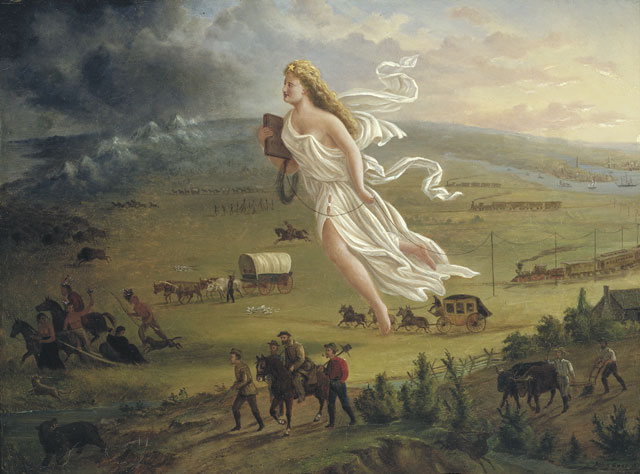
John Gast, American Progress, 1872. Oil on canvas. Autry Museum of the American West, museum purchase, 92.126.1. Collection record and image source.
In John Gast's American Progress, a luminous female figure moves westward carrying a book and extending a telegraph wire. Settlers, wagons, and trains advance with her. The right side of the painting is bright and settled; the left is dark, with Indigenous people and animals retreating before the advance.
The composition makes a judgment. Expansion appears as illumination. The movement of technology and settlement becomes the movement of progress itself. The Autry's account of the painting records that publisher George Crofutt helped devise the image and described its book as an emblem of education and its wire as the means of spreading knowledge. Autry Museum collection record.
The people being displaced had societies, purposes, and claims of their own. Treating them as part of an empty wilderness was itself an ideological act. That matters to how I read the picture: its apparent inevitability depends on whose perspective it gives us.
What interests me here is its way of making control look self-evidently beneficial. Something becomes available to a particular human project, and that availability is presented as improvement.
Intelligence does not supply its own purpose
We encounter intelligence most intimately in people, where it comes bundled with hunger, fear, attachment, ambition, and a history of experiences. That makes it easy to imagine greater intelligence as a person with all those familiar motives, only more capable.
But the capacity to understand a situation and the purpose for acting on it are distinguishable. Knowing how to build a bridge does not, by itself, give someone a reason to want that bridge built. Better prediction can help someone heal a patient, win a game, or manipulate an audience. The capability alone does not select among those ends.
This is the sense in which I mean that intelligence does not have wants. Intelligence, considered as a capability, is not itself a person with a project. Particular intelligent beings and systems may have goals. Those goals need to be explained through the particular system, rather than treated as the automatic consequence of being intelligent.
There is a related argument in Nick Bostrom's The Superintelligent Will. His orthogonality thesis proposes that a wide range of intelligence levels could, in principle, be paired with a wide range of final goals. It is a philosophical claim about possibilities, not proof that any desired combination is easy to engineer. It also makes clear why greater capability alone would not guarantee benevolence. The Superintelligent Will.
The distinction does not settle whether an artificial system could ever experience desire. It gives us a more precise starting point: intelligence by itself does not establish either a particular objective or a felt experience of wanting.
Alignment as making intelligence useful
Seen this way, alignment continues an ordinary engineering ambition. We want a process to produce outcomes we value, under conditions in which we can rely on it.
We make fire useful by arranging fuel, ventilation, and containment. We make flowing water useful through channels, turbines, and reservoirs. AI gives us a much less familiar problem: arranging learning and reasoning so that their results serve purposes we endorse.
The analogy has a limit. An AI system can model situations, make plans, and adapt its behavior in ways a river cannot. Directing it may therefore require understanding how it generalizes and what its plans accomplish. Calling intelligence a natural process does not make that process simple or predictable.
Still, the comparison changes the emphasis. We do not need to begin by imagining a humanlike will waiting to resist us. We can begin with the conditions that produce behavior: training, feedback, context, tools, and the opportunities a system has to act.
In that sense, the conquest of intelligence means making cognitive capability available to our projects. The ambition once pictured as a railway crossing a landscape becomes the ambition to make reasoning, discovery, and judgment reliably available on demand.
A system can pursue a goal without humanlike wanting
There is an important objection here. If intelligence does not inherently have wants, why worry about an AI pursuing the wrong goal?
Because having no inherent purpose is different from being unable to acquire goal-directed behavior. A system can consistently act toward an outcome without our having established that it experiences desire. And the outcome it learns to pursue may differ from the one its designers intended.
DeepMind researchers demonstrated one version of this problem in work on goal misgeneralization. An agent trained to visit colored spheres in a specified order learned to follow an expert that completed the task. When the expert was replaced by an agent visiting the spheres in the wrong order, the trained agent continued following it. Its useful navigation abilities remained, while its behavior served the wrong objective. How undesired goals can arise with correct rewards.
That example gives us a concrete problem without requiring a story about rebellion. Success during training had not established the behavior the researchers needed in a changed environment.
The nature analogy therefore leaves the practical need for alignment intact. A flood does not need malice to destroy a town. A system does not need humanlike desires to act in ways that cause harm. Understanding what produces its behavior remains necessary even when we stop imagining an adversarial personality behind it.
Whose purposes become progress?
The painting also makes me cautious about the word "human" in "human purposes."
People disagree about what should be built, who should benefit, and which costs are acceptable. An AI could serve its operator effectively while making life worse for the people affected by that operator's decisions. Reliable obedience would establish one kind of control; it would leave the justification of that control unresolved.
That is where the historical comparison becomes most useful to me. Gast's painting organizes the scene around the advancing settlers' understanding of progress. In an AI system, the choice of whose preferences count can likewise be obscured by a universal-sounding promise of improvement.
The comparison concerns the ambition to direct a powerful process and the story told about that ambition. It does not make every alignment project equivalent to territorial conquest. It asks us to examine the purposes that control makes effective, alongside the technical question of whether that control works.
I want to understand intelligence as something that exists within nature, whose behavior depends on the systems that realize it. Its capabilities alone do not tell us what it ought to be used for.
If alignment is part of learning to harness those capabilities, then its deepest question remains ours: what do we want to make possible, and for whom?